 |
 |
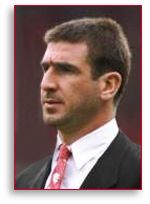
Eric Cantona |
|
|
Eric Cantona |
| ERIC CANTONA Birthplace: Marseille,
France, 24/5/1966 |
 |
| Eric Cantona was born in Marseille
on the 24th May 1966. In May 1981 he joined Auxerre and
by 1982 was in the French national youth team. After
making his first team debut in 1983 Cantona spent 1984
doing his national service in the French Army. Farmed out
to Second Division Martigues on loan to help gain first
team experience he returned to Auxerre to be offered
professional terms for 1986-87 season. His performances
for Auxerre attracted attention from both the Under 21
and national team managers. Making his full international
debut versus West Germany on 12th August 1987, Cantona
scored France's goal in a 1-2 defeat. In 1988 he helped
the under-21 side to victory in the European
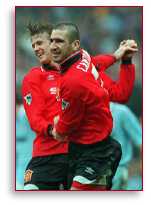
Championships. In June 1988 Cantona signed for Olympique-Marseille for a French record fee of £2.3 million, a dream move to the team he had supported in his youth. However, despite a public apology, he was soon banned from all international matches after insulting Henri Michel, the French manager. He was in further trouble in January 1989 when, after throwing his shirt to the ground when being substituted in a friendly versus Torpedo Moscow, Cantona was suspended by Marseille. A loan move to Girondins-Bordeaux was organised and in July 1989 he signed for Montpellier-Herault. By the end of 1989-90 season Cantona had helped Montpellier to victory in the French Cup Final and had been recalled to the national team by new manager, Michel Platini. Whilst at Montpellier he was suspended for 10 days after a dressing room fight with a team-mate. Signing once again for Marseille in the summer of 1990 Cantona became a valuable member of a star-studded team. His successful return to Marseille was halted in October 1990 when a knee ligament injury sidelined him for 3 months. Unable to gain a regular place in the Marseille line-up during the rest of the season Cantona joined Nimes-Olympique for £1 million. Appointed Captain, Cantona was again soon in trouble with the football authorities. Sent off after throwing the ball at a referee he was summoned before the disciplinary committee of the French F.A. Given a one month suspension, Cantona called each member an idiot and found his suspension doubled to two months. Deciding that enough was enough Cantona signed a cancellation of his contract and in December 1991 announced his retirement. Persuaded to consider playing in England, Cantona joined Sheffield Wednesday but with the club apparently unwilling to sign him without a trial period first, Cantona walked out. Leeds United quickly stepped in signing him on 31st January 1992. Making his debut as a substitute versus Oldham on 8th February, Cantona scored his first goal versus Luton Town on 29th February. By April Cantona had become a firm favourite with the Leeds supporters who responded with 'Ooh Aah Cantona' chants whenever he played. Cantona became a cult hero at Elland Road especially after his skills and goals helped clinch the 1992 League Championship and his hat-trick versus Liverpool won the Charity Shield. Surprisingly Cantona struggled to hold a regular place in the Leeds team the following season culminating in a shock move across the Pennines to Old Trafford on 27th November 1992 for £1 million. Making his first team debut in a friendly match to celebrate the 50th birthday of Benfica legend Eusebio, he made his league debut as a substitute in a 2-1 victory over Manchester City on 6th December 1992. His first goal in United's colours came in a 1-1 draw at Chelsea on 19th December. The arrival of Cantona galvanised United's squad into championship form to bring the club it's first Championship in 26 years. Cantona had now also become the first player to win consecutive English League Championship medals with different clubs. Even more success was to come the following season when Cantona helped United to a League and Cup double. United's top scorer with 18 league goals he scored two penalties in a 4-0 victory over Chelsea in the 1994 F.A. Cup Final. His role as the creative genius at the heart of United's team was recognized by his peers when the Professional Footballers Association's members voted him 'Player of the Year' for 1994. Despite all this success there was still concern over Cantona's disciplinary record. On his return to Elland Road as a Manchester United player he had spat at a Leeds fan, gaining a £1,000 fine. Sent off versus Galatasaray in the European Champions League he allegedly called the referee a cheat and became involved in scuffles with Turkish policemen, eventually being banned for 4 European matches. In 1994 Cantona was sent off twice in the space of 4 days, versus Swindon Town and Arsenal, receiving a 5 match ban. He was also involved in a couple of alleged stamping incidents. In July 1994 at the World Cup Finals he found himself handcuffed and ejected from the press box after swinging a punch at an official. Sent off again in a pre-season tournament against Rangers, Cantona gained a further 3 match ban. Sent off again against Crystal Palace on 25th January 1995 for retaliation, Cantona responded to a stream of racist abuse from Crystal Palace 'fan' Matthew Simmons by jumping over a barrier and assaulting him. Already one of the most newsworthy of players this attack made front and back page news for weeks on end. Manchester United quickly announced that Eric Cantona would be fined the maximum his contract allowed and that he was suspended from all first team matches until the end of the season. Criticism of Cantona came from almost all sides with some journalists, players and commentators suggesting that only a life ban would be sufficient punishment. In February an F.A. disciplinary commission extended this ban to include all competitive matches until the end of September, and issuing another fine - this time £10,000. F.I.F.A., football's world governing body, extended this ban worldwide. The French F.A. also removed him from captaining the French national team. By March the legal system had swung into action and, after being convicted of common assault, Cantona was sentenced to 2 weeks in jail. After a public outcry that he was hardly a danger to society, Cantona saw his sentence reduced on appeal to 120 hours community service. Manchester United kept faith with their errant star player offering a new three year contract in March 1995. Whilst suspended, and holidaying on the French island of Martinique with his pregnant wife, Cantona attacked an ITN reporter who had broken the strict French privacy laws. For United the loss of Cantona dealt a severe blow to the club's hopes of retaining their 'double' crown. Cantona returned to action with United on 1st October 1995, versus Liverpool, setting up one goal and scoring the second in a 2-2 draw. United's hunt for a third championship in four years was undoubtedly boosted by the Frenchman's return. Cantona quickly adjusted to the pace of the Premier League games and towards the end of the season was appointed team captain. Victory over Middlesbrough in the final match of the season sent the Premiership trophy back to Old Trafford and less than a week later Cantona led out United as captain in the F.A. Cup Final against Liverpool. Cantona's 86 minute goal gave United a unique 'double-double' and made him the first foreign player to captain an F.A. Cup winning team. Awarded the Football Writers' Player of the Year trophy for 1996 Eric Cantona became the first United player to win this very prestigious award since George Best in 1968. His outstanding performances and exemplary disciplinary record in 1995-96 season saw a number of calls for his return to the French national team. However, it now looks like Cantona may have played his last match for his country and will not add to his 43 appearances and 19 goals scored. Lauded as a genius in England, where he has achieved cult and god-like status at Old Trafford, Cantona is less highly rated in his homeland where he is thought of as a good player but regarded as a 'bad-boy'. Cantona has claimed to be a poet, philosopher and artist since his arrival in England but it is his coolness on the pitch, his vision, flicks and passing skills and his goalscoring record that has won him the adoration of the Old Trafford faithful who have crowned him the new 'King' of Old Trafford. Up until the end of 1995-96 season Cantona had made 106 league appearance (plus 1 as a substitute), scoring 53 goals. In the 1996-7 season Eric Cantona took over from Steve Bruce as club captain and although some supporters saw what was to be his last season with Manchester United, his quietest. However, he still managed to captain United to the semi-final of the European Cup and to a fourth Premier League Championship. Approximately a week after the 1996-7 season finished Eric Cantona announced that he would be retiring from professional football with immediate effect. He has since returned to France with his family to pursue an alternative career. Did You Know? Eric Cantona won a French Cup medal in 1990, whilst playing for Montpellier. He has won six League Championship Medals in the last seven years. Marseilles 1991, Leeds United 1992, Manchester United 1993, 1994, 1996 and 1997. Eric Cantona’s strike rate with Manchester United was a goal every other game. In six appearances at Wembley Eric Cantona scored eight times The only time he has failed to score was the 1993 Charity Shield versus Arsenal. (However he did score one of the penalties in the shoot out). Eric Cantona’s first team debut for United was in a testimonial for Benfica legend, Eusebio, in November 1992. His last game for Manchester United was also a testimonial for the Coventry player David Buust on 16th May 1997, at Highfield Road. |